philosophy · 7 min
Human: what for?
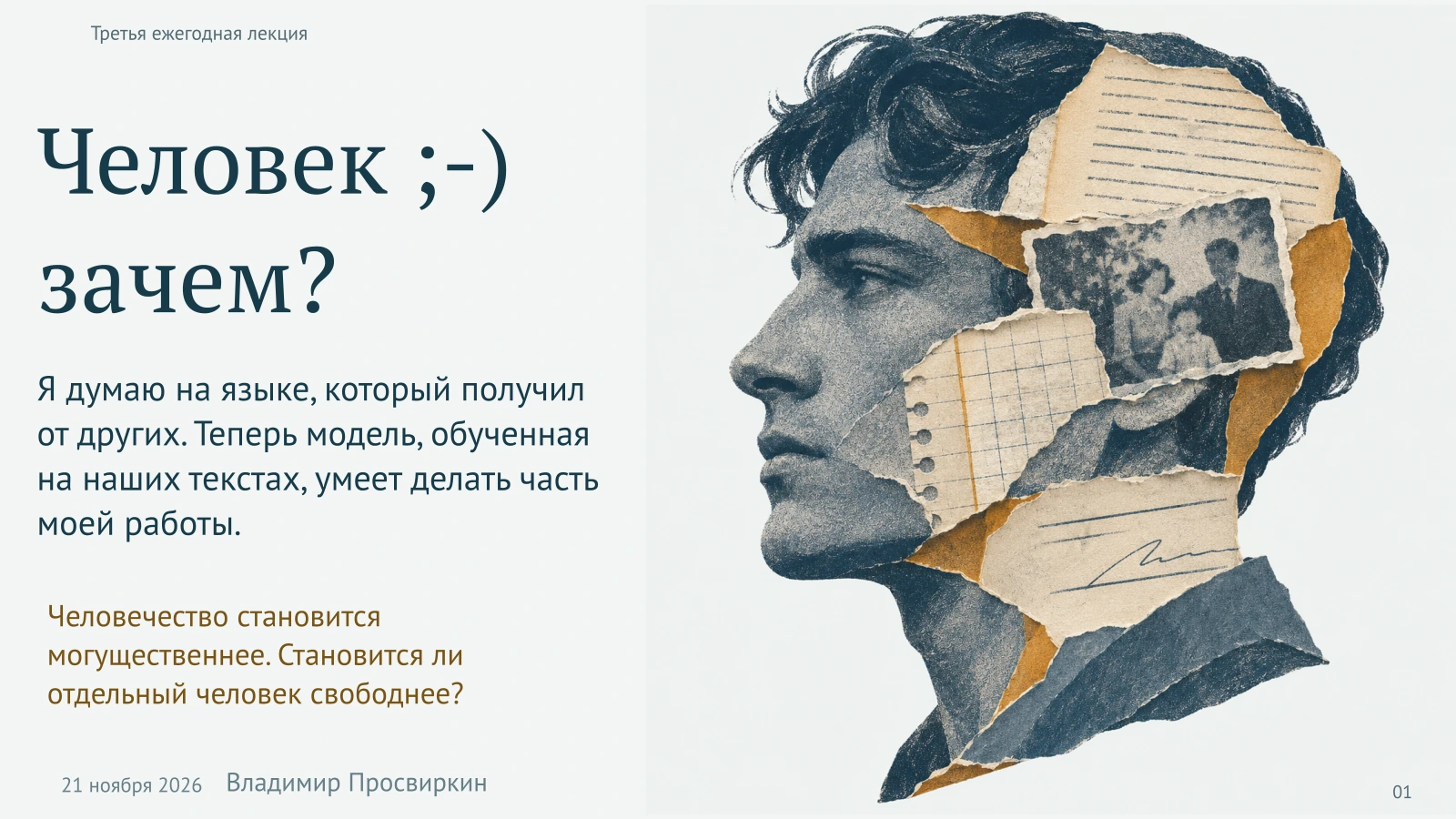
Try to name one thought you came up with yourself. My third birthday lecture: what is left of a person once a machine can think too.
Try to name one thought you came up with yourself. Not heard, not read, not picked up from your feed. Actually came up with.
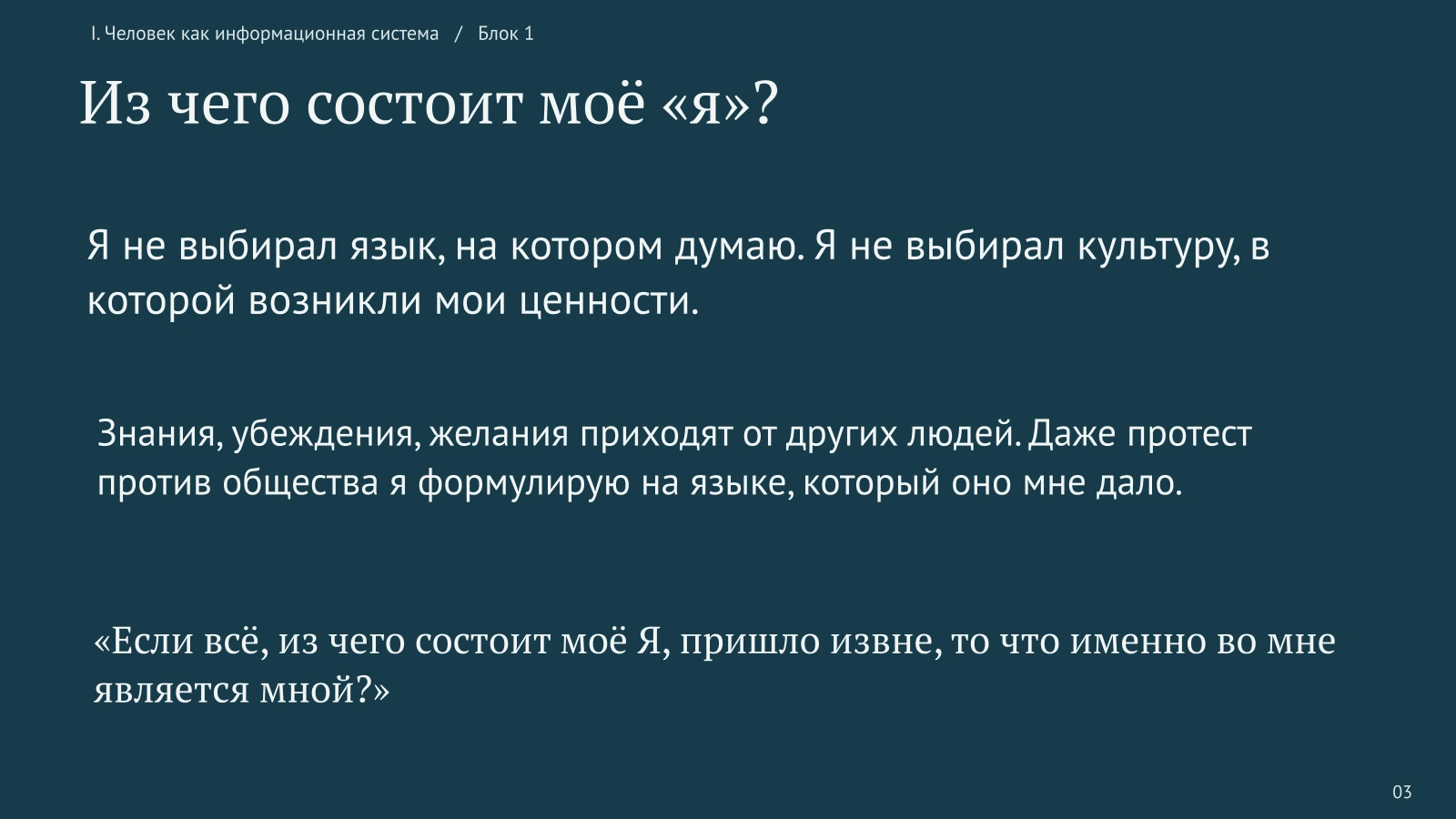
I couldn't. I think in a language someone handed me. My values grew out of a culture I didn't choose. My desires were mostly sold to me. Even "screw all of you, I'll live my own way" is built from words that "all of you" taught me.
Now add AI to the picture: trained on our texts and already doing part of our work. If my "self" was assembled from outside to begin with, and a machine can now do the thinking too, what is still mine? And what am I for?
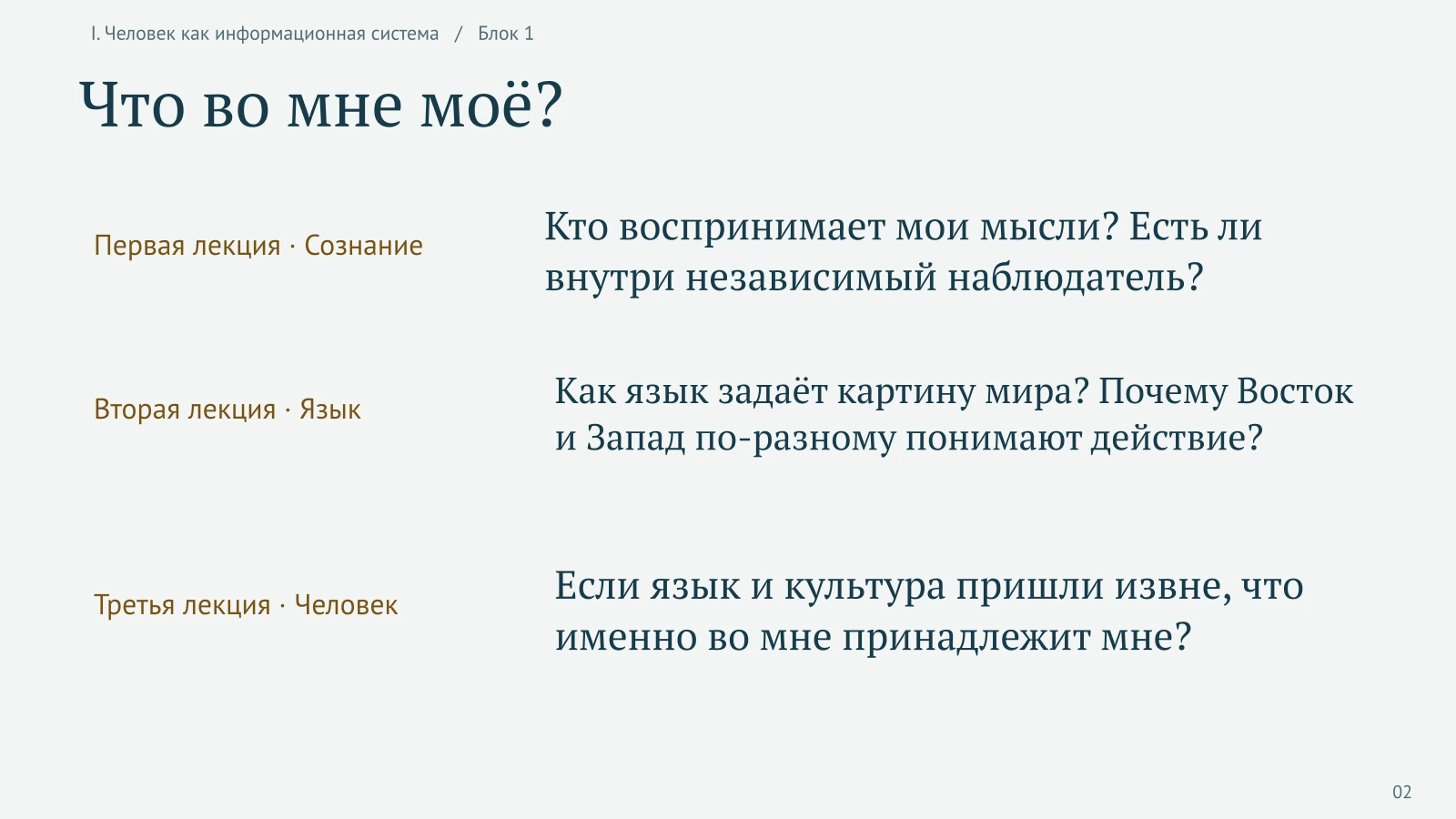
I brought that question to my birthday. Once a year I get my friends together and give them a lecture. The first was about consciousness, the second about language, and the third was called "Human: what for?" Here it is as text.
People were never separate
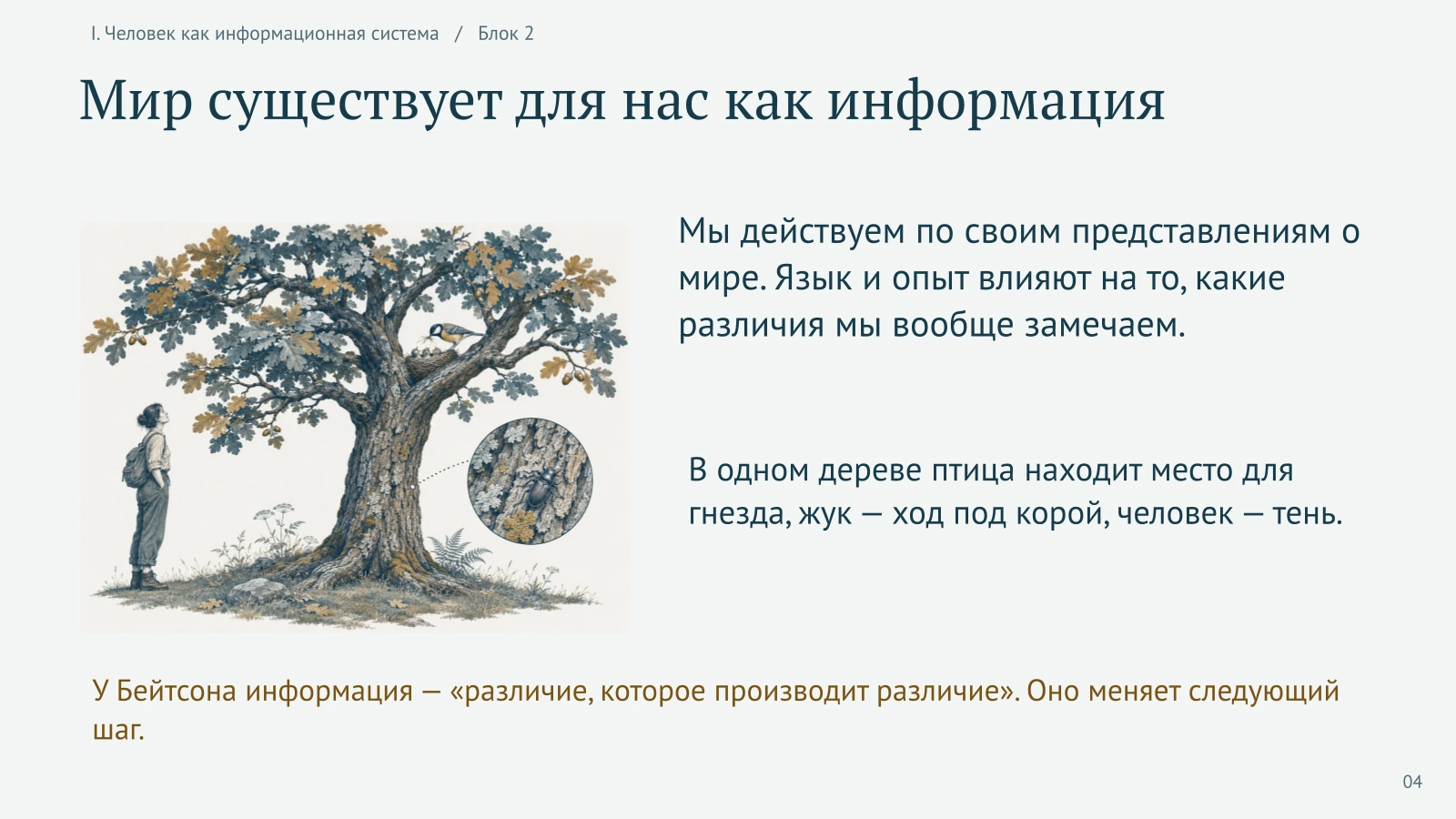
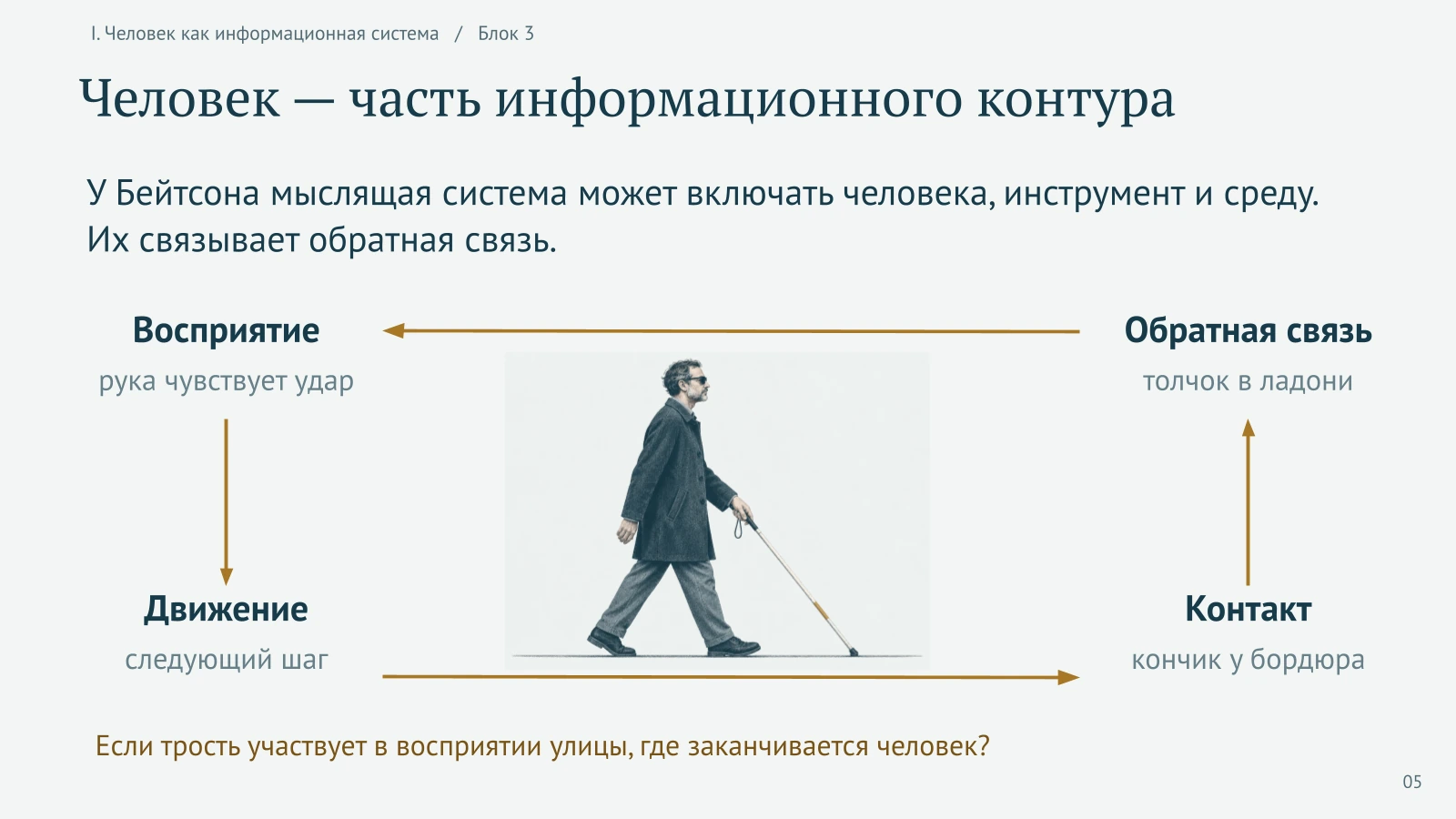
Gregory Bateson has a blind man walking down the street with a stick. The tip hits the kerb, the hand feels the jolt, the man lifts his foot. Where does the man end? At the wrist? Then the explanation loses exactly the thing that made him take the step. The whole system is doing the thinking: the man, the stick and a piece of the street. Gregory Bateson, "Form, Substance and Difference"
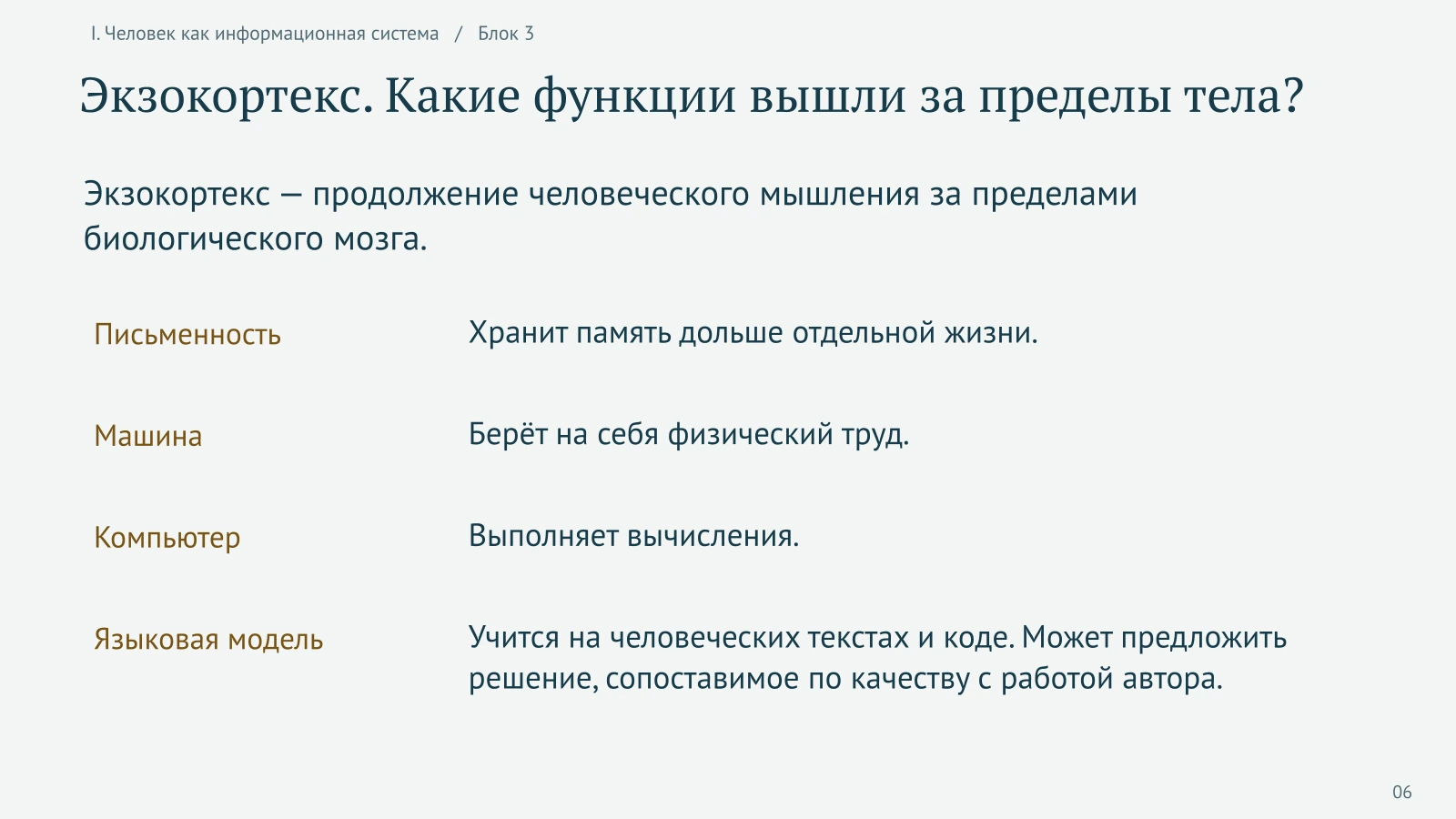
All through history we've been moving parts of ourselves outside. Writing took memory. Machines took muscle. Computers took arithmetic. AI is taking what we used to call thinking: phrasing, comparing, proposing a solution. There's a clever word for it, "exocortex", an outer layer of the brain.
I live in this quite literally. I'm building a personal operating system for working with AI, and at some point it started improving itself so that I could spend more time on my projects. Very convenient. And slightly unsettling: where exactly do I end now?
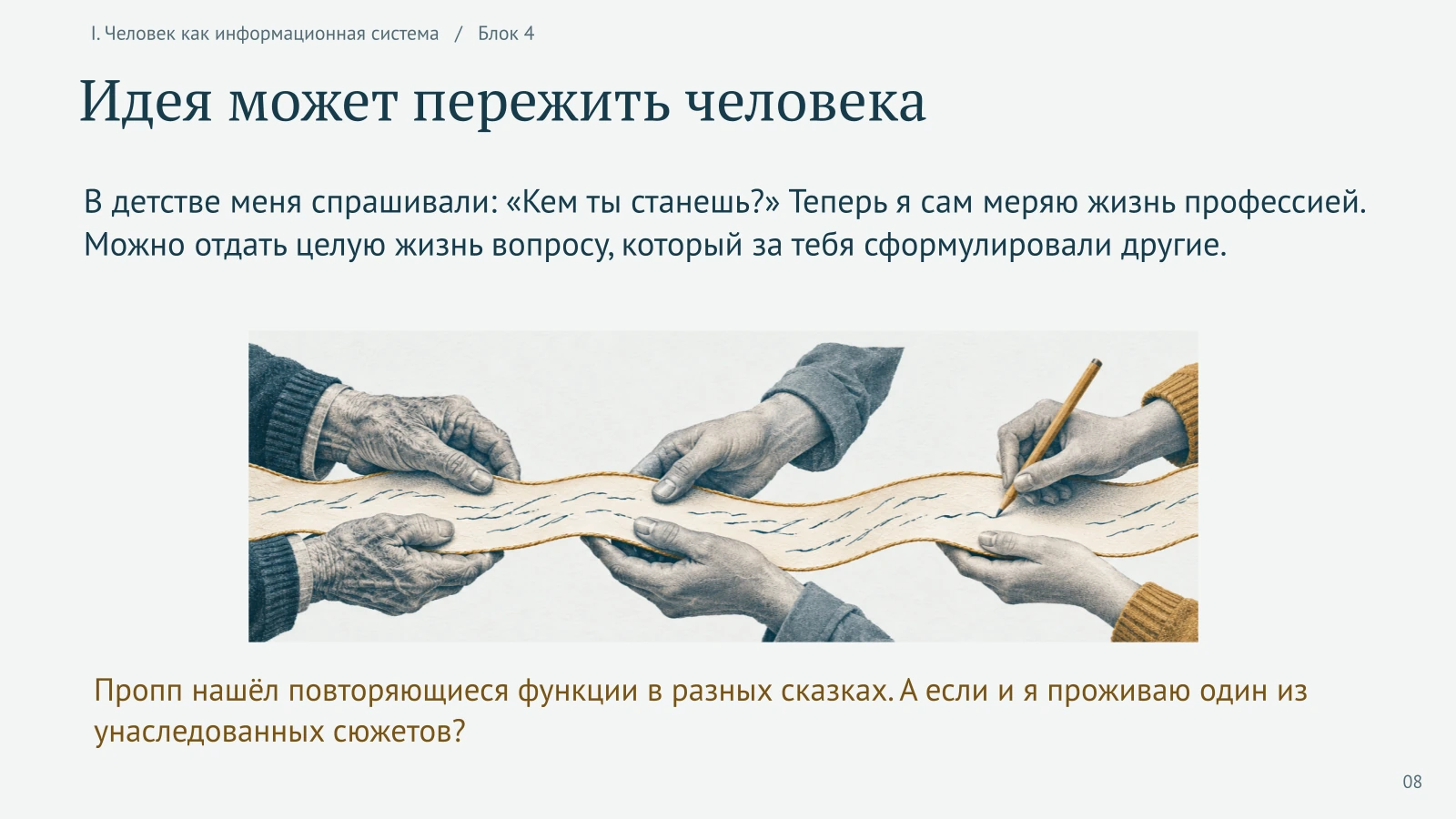
Ideas work the same way. Vladimir Propp took a hundred Russian fairy tales and found thirty-one recurring functions in them: a ban, a violation, the hero leaving home, a helper, the return. A plot feels unique until you see the ready-made parts. Ideas outlive people and travel through us like passengers. A person can give their only life to an idea somebody else came up with.
So what interests me is something else: at what moment does someone else's question become mine?
What a cultural animal lives for
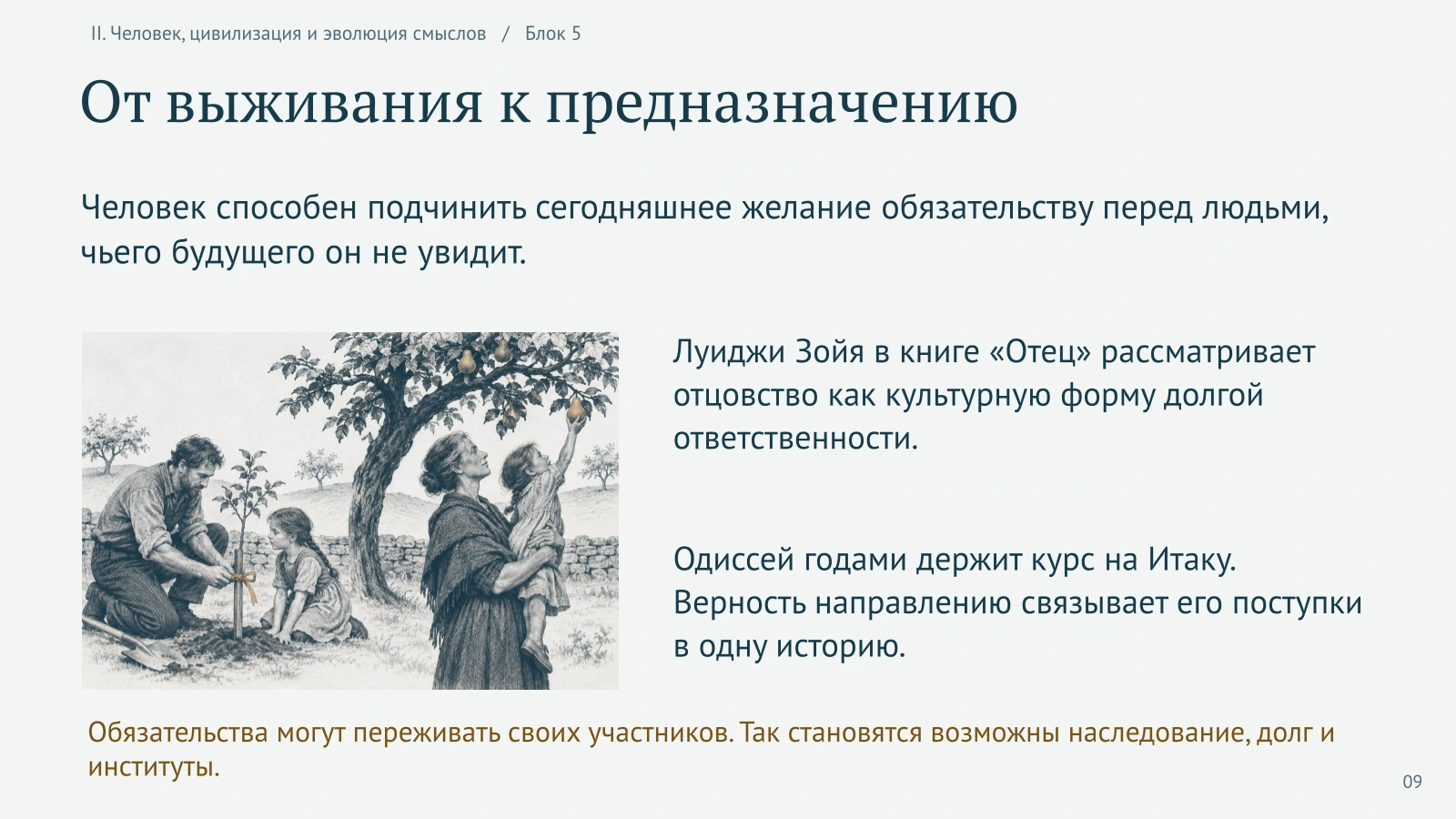
Biology wants very little from us: survive and leave offspring. Humans are strange. We'll sacrifice today for a future we won't see. That gives us duty, inheritance, institutions. In "The Father", Luigi Zoja shows that even fatherhood rests more on culture than on instinct: it has to be built and handed down. Odysseus spends twenty years sailing home, and what makes him a hero is less the number of his feats than the fact that he never changes course.
Civilisation starts where a person does something for the sake of what will outlive them.
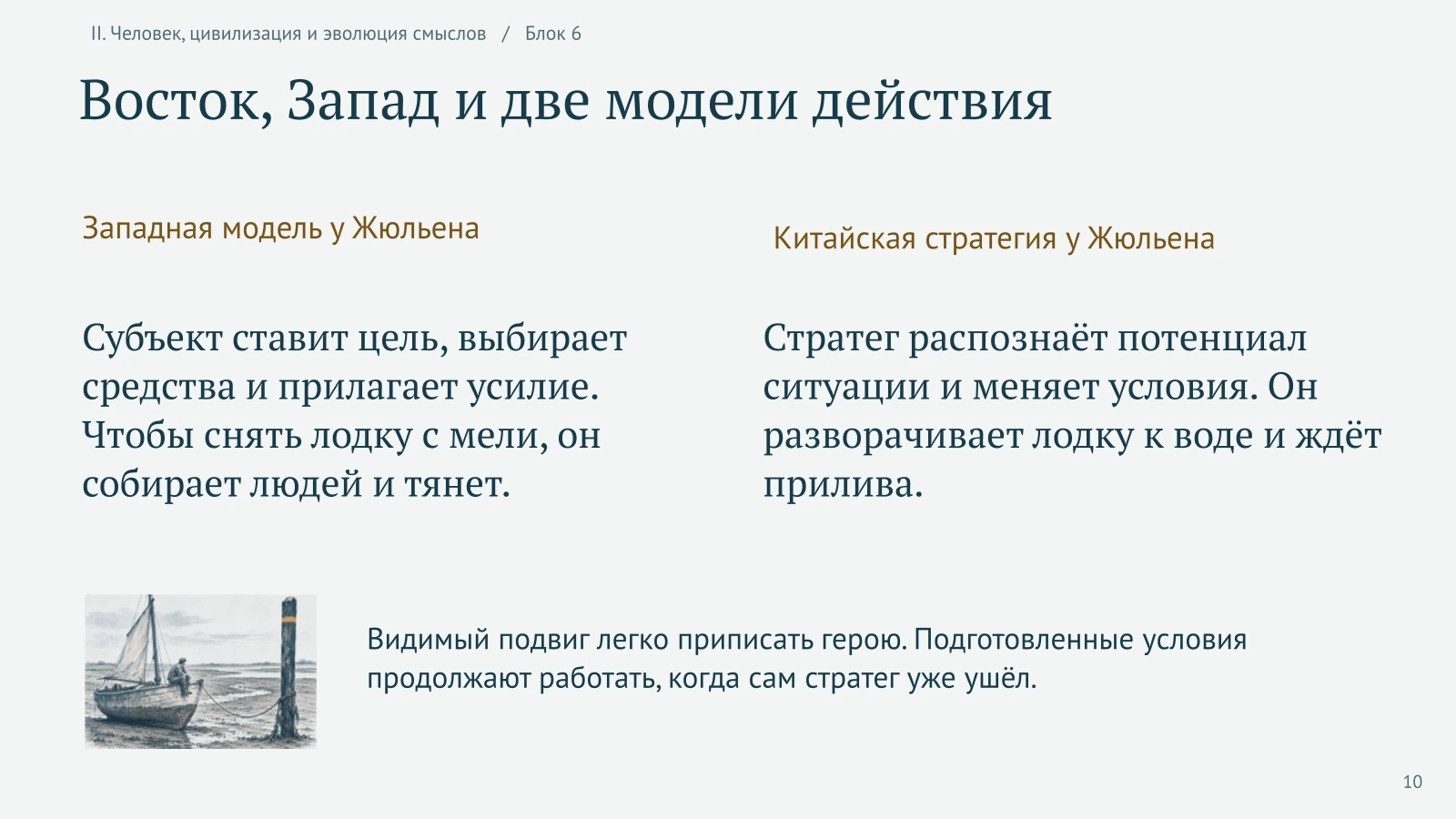
There are two ways to do it. The Western hero sets a goal and bends the world to the plan. François Jullien describes the logic of Chinese strategy with a boat stuck on a sandbank. You can round up twenty people and pull. Or you can spot the high-tide mark on a post, turn the bow and wait for the water. The boat moves by itself, and nobody can point at whoever moved it. François Jullien, "A Treatise on Efficacy"
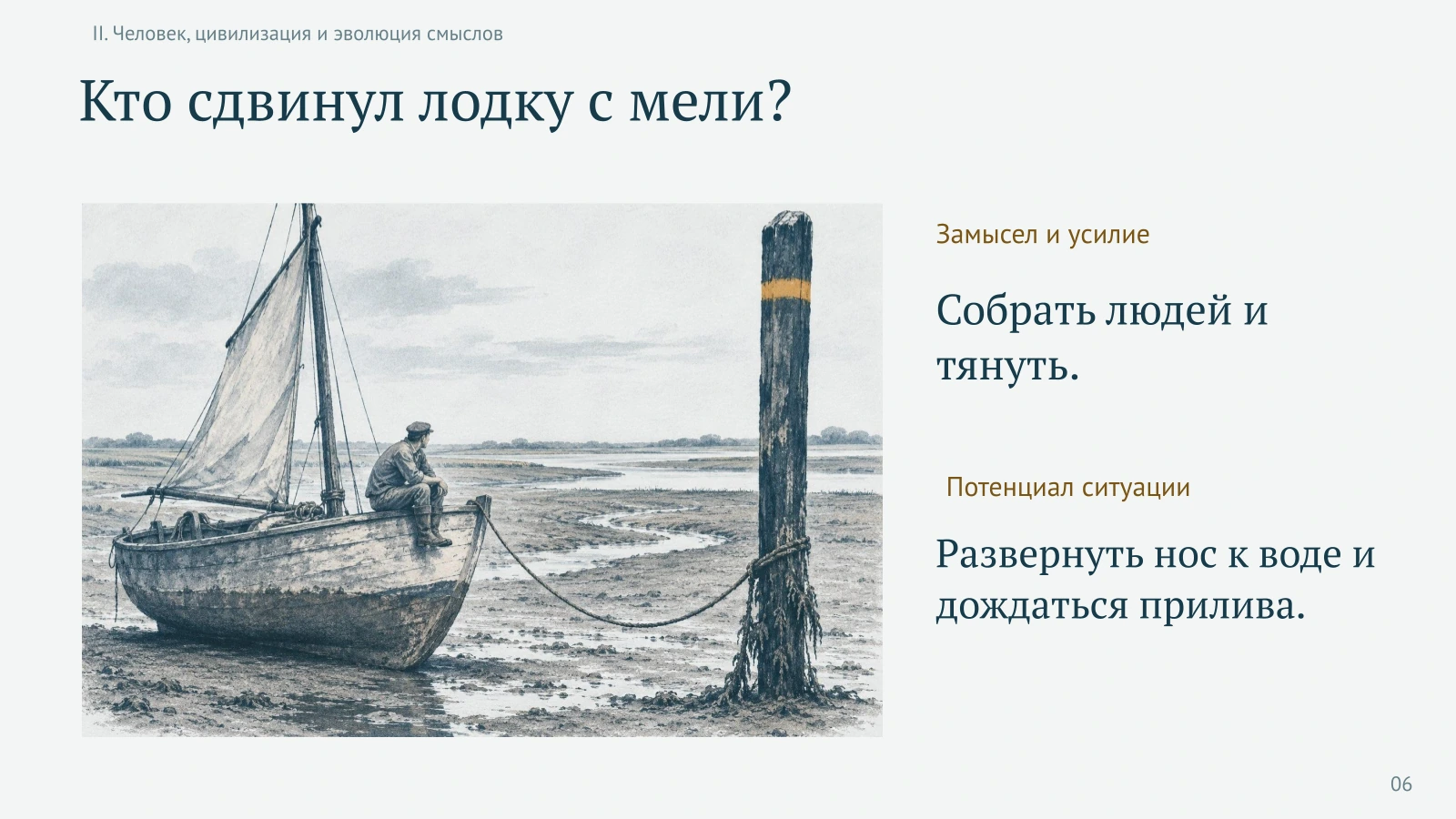
Remember that boat. It will turn out that this is how we get moved too.
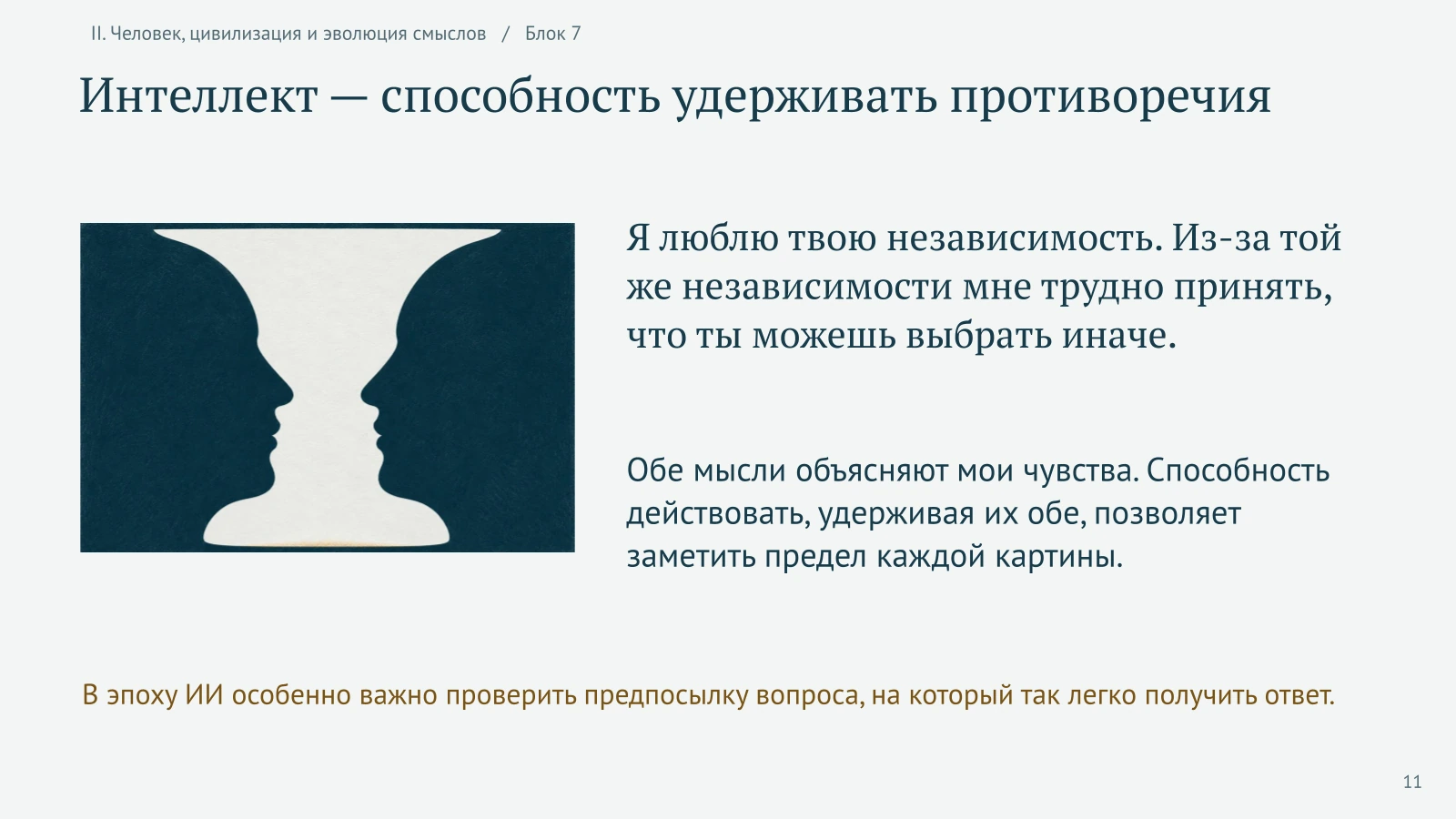
One more thing. Fitzgerald wrote that the test of a first-rate intelligence is the ability to hold two opposed ideas in the mind at the same time and still retain the ability to function. A reason to do something often turns out to be a reason not to. A person we love for their independence can't be controlled, and that's exactly what makes them hard to live with. Machines are great at handing out ready answers. Holding a contradiction and asking a new question is, for now, still a human job.
Why own a person when you can steer their desires
Money, status, reputation and "success" exist only because enough people believe in them. Yet people work their whole lives for them. The most expensive things in the world live in our heads, and we pay for them with real time.
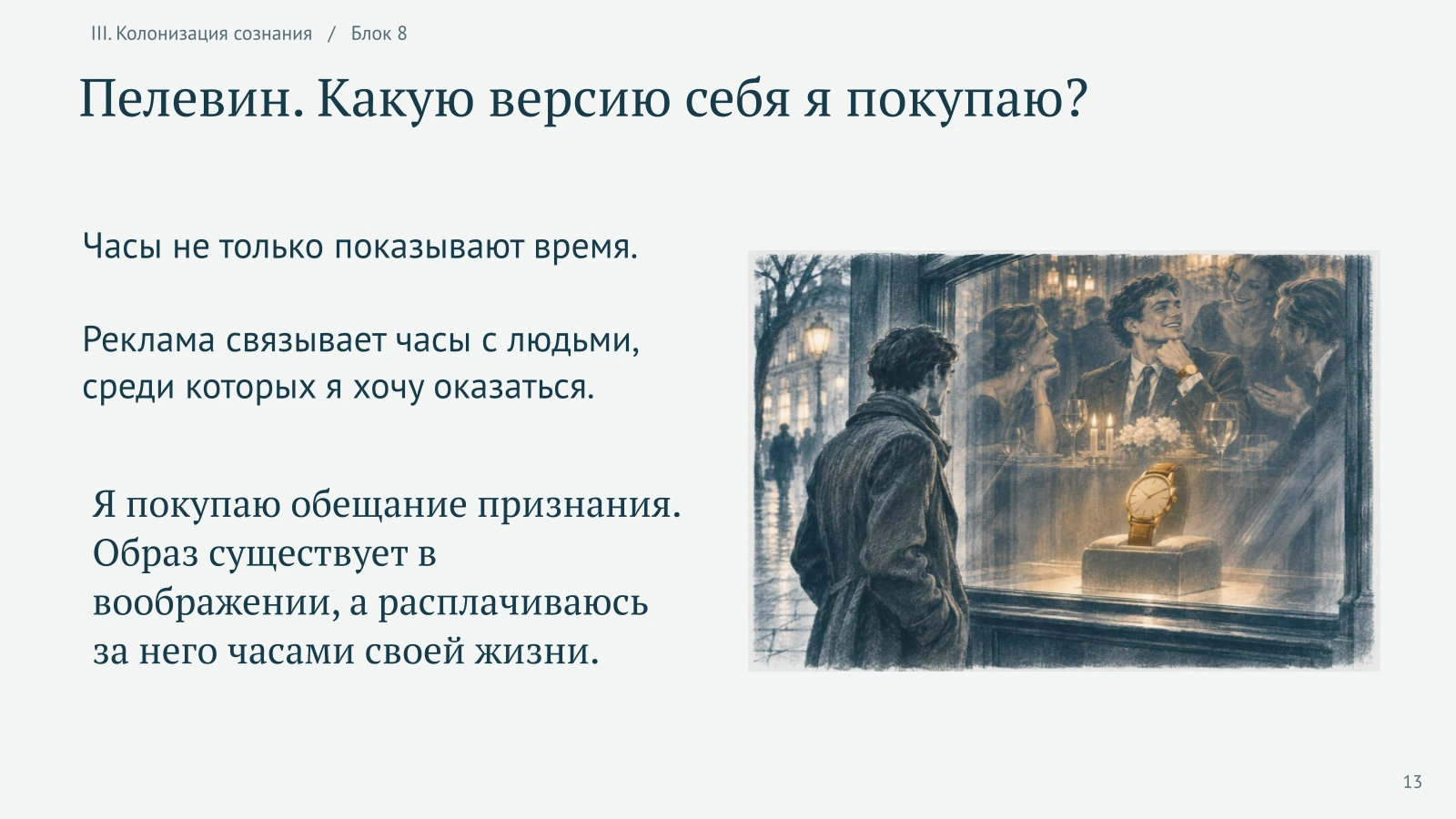
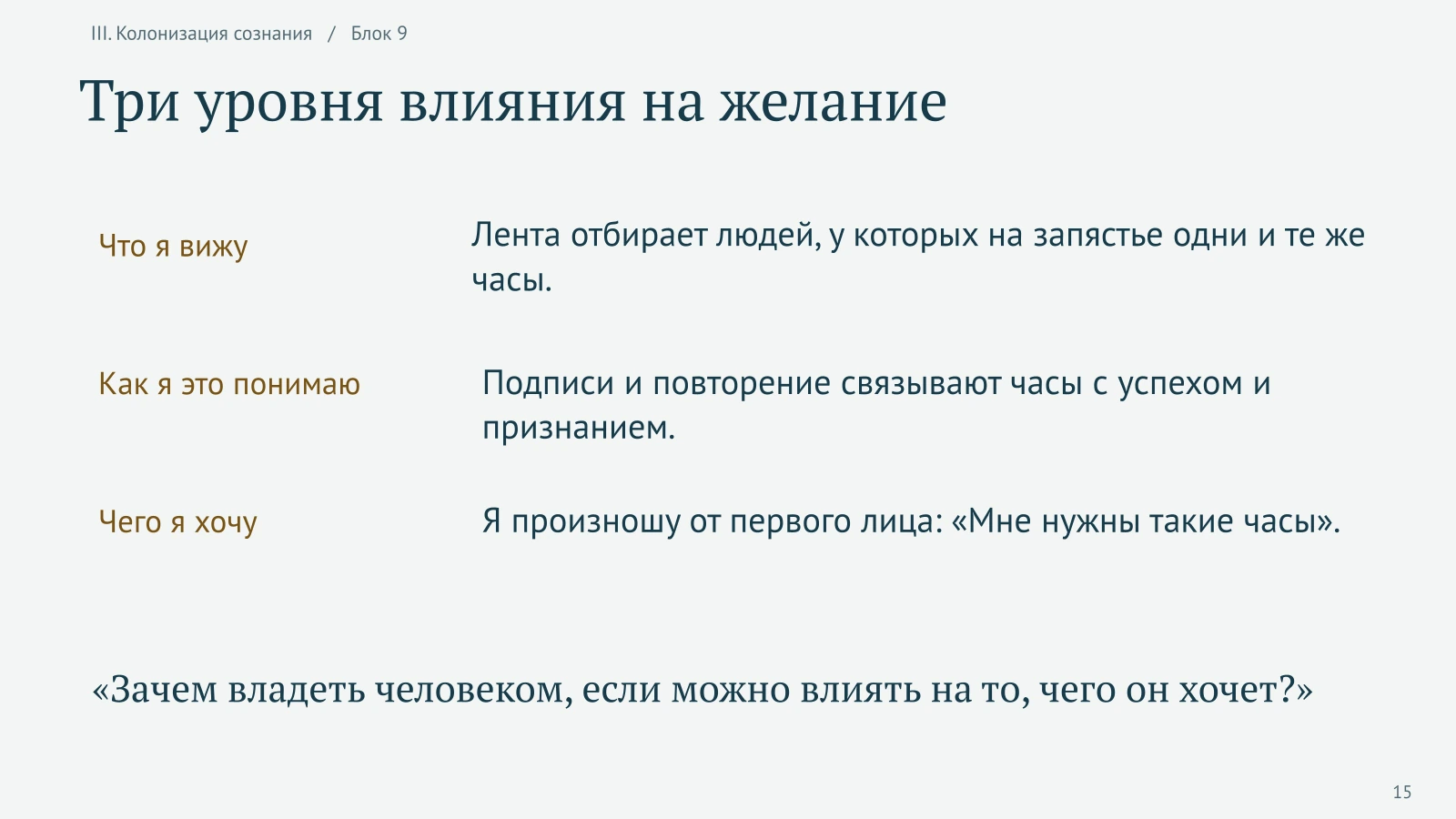
Victor Pelevin put it best in "Generation P": advertising doesn't sell a product, it sells the version of you that you'll become once you buy it. I'm standing at a window full of expensive watches. My phone already tells me the time. I barely look at the dial, but I can already picture which friend will be first to notice it on my wrist. How did that friend get into the shop in my head? Victor Pelevin, "Generation P"
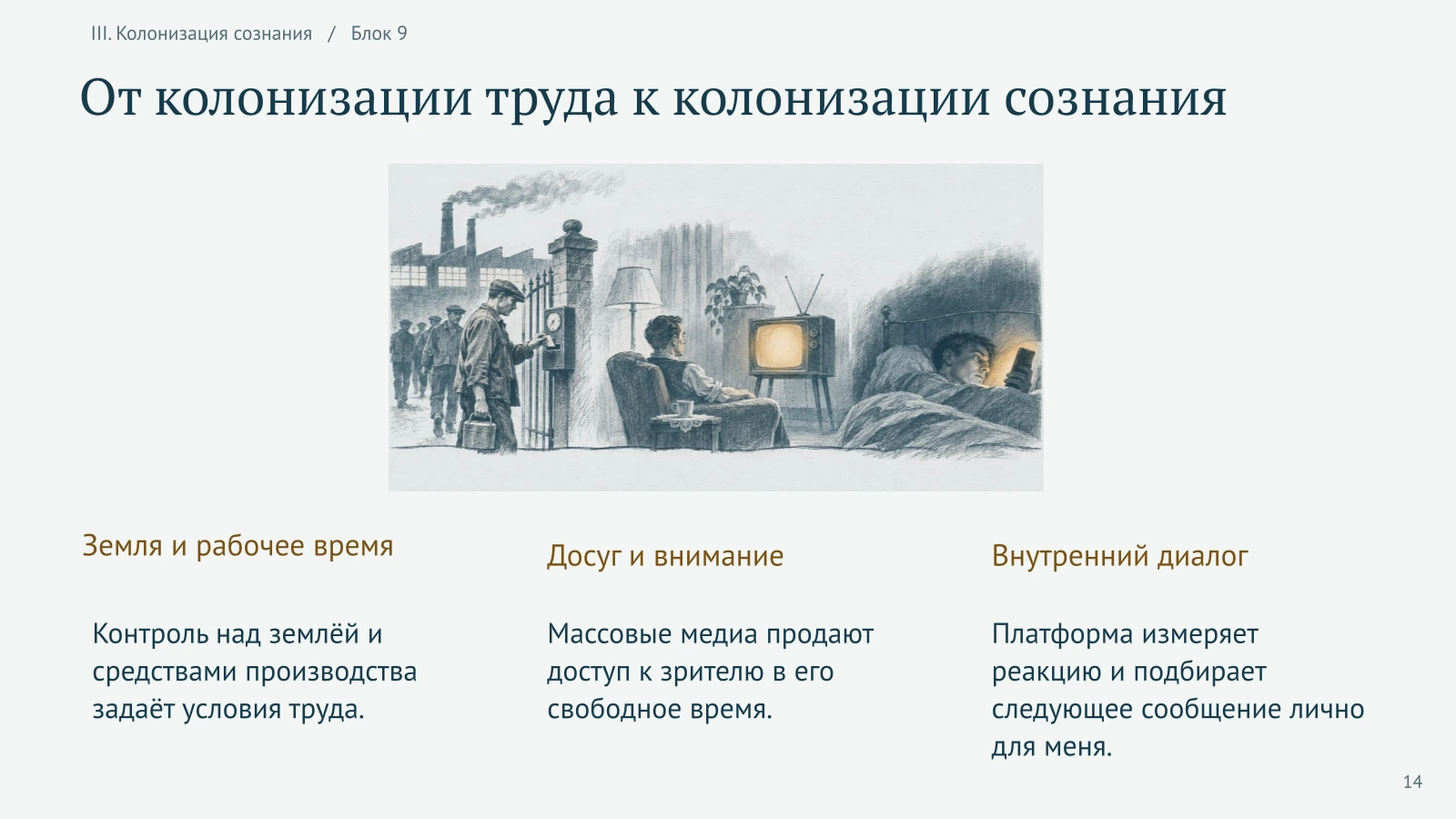
The factory needed my eight-hour shift. Television needed my evening. The feed needs my inner monologue. Reels and Shorts learn from every second I linger, and a month later I say, quite sincerely, "I like that kind." And I really do. The question is what route the watch travelled before it reached the word "I".
Here's Jullien's boat from its unpleasant side. Nobody drags me to the till. They just shift, bit by bit, the circumstances in which I'll reach for my wallet myself. There are three levels to it. First they decide what you see. Then how you read it. Then what you want. Why own a person if you can shape their desires? The best advertising is the kind after which a person is sure they wanted it all along.
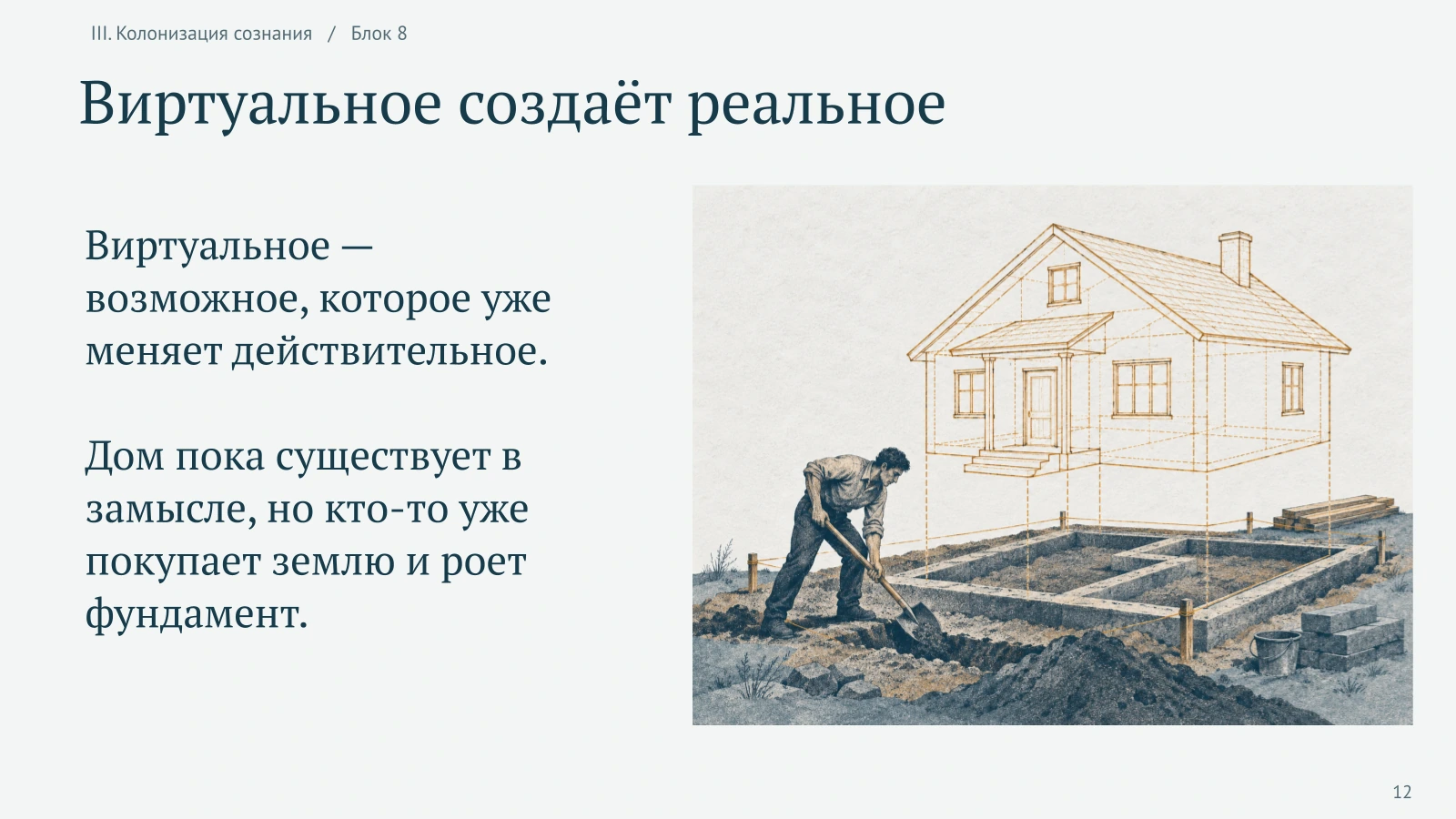
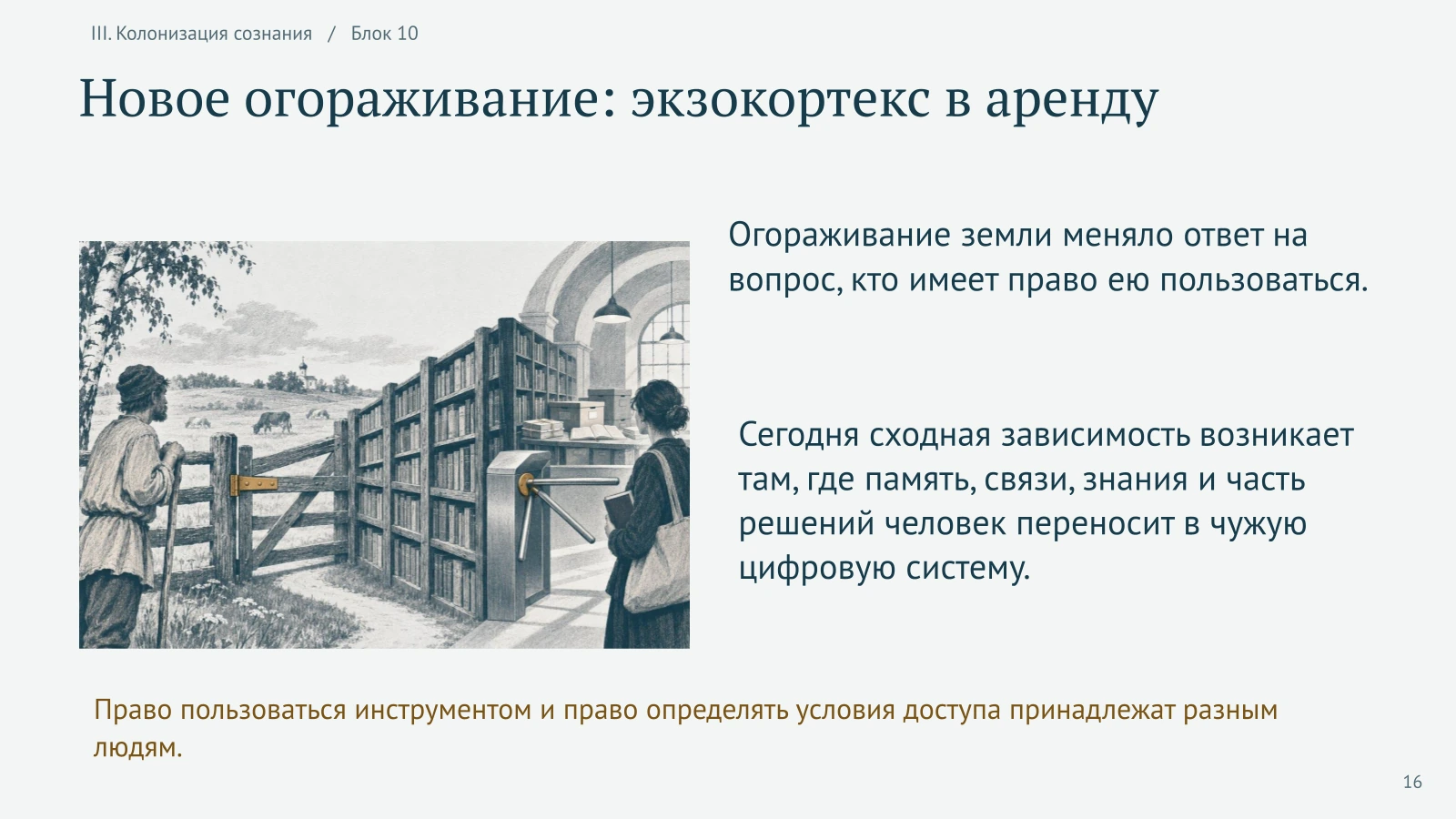
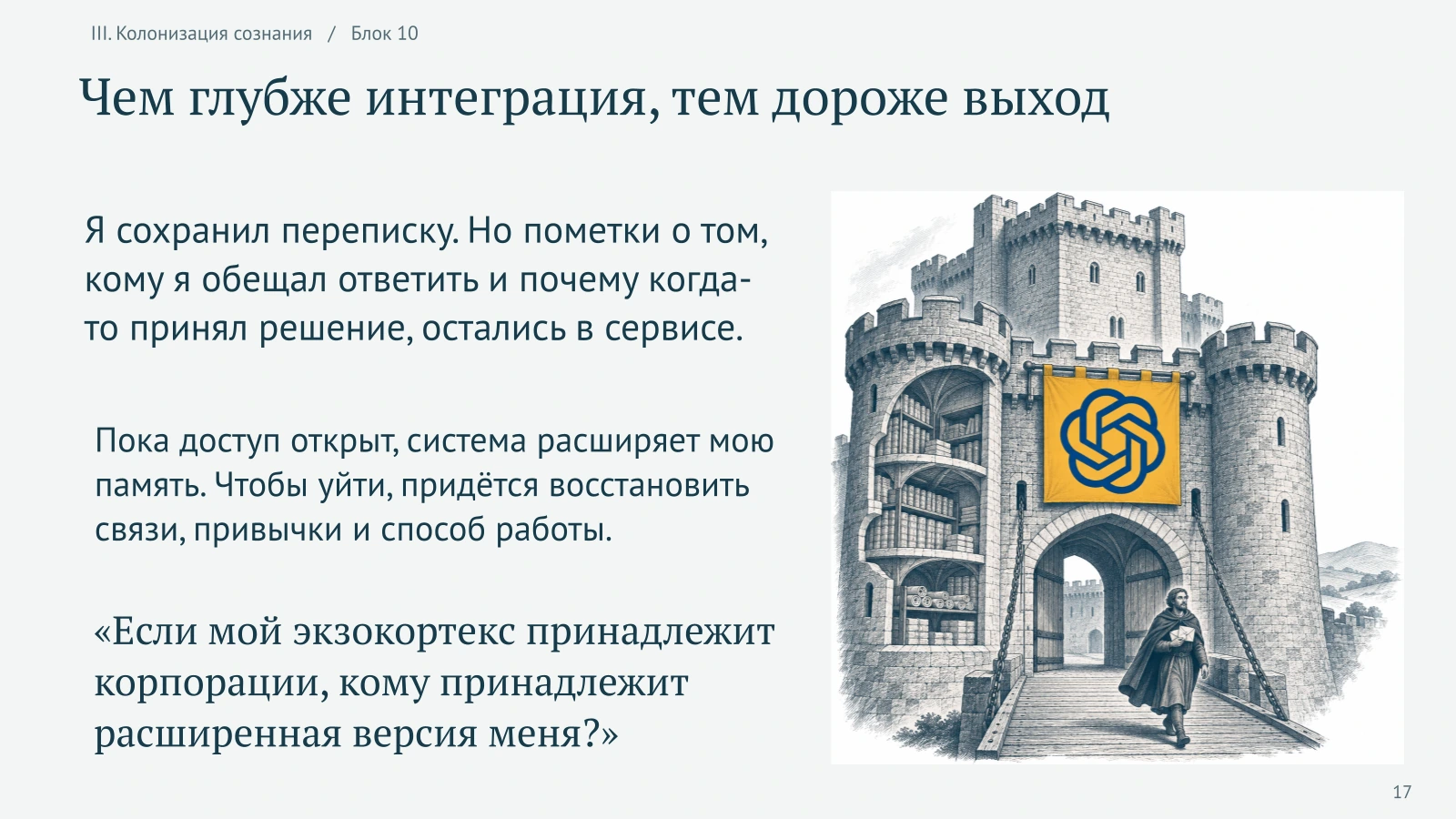
It gets worse. Land used to be enclosed. Now the infrastructure people think through is being enclosed. I move memory, workflows and some of my decisions into someone else's service. The deeper I grow into it, the more it costs to leave. Using is not owning. If my exocortex belongs to a corporation, who owns the extended version of me? That's why my own system keeps its memory, decision history and working rules with me, not with the model vendor.
Gods and pets
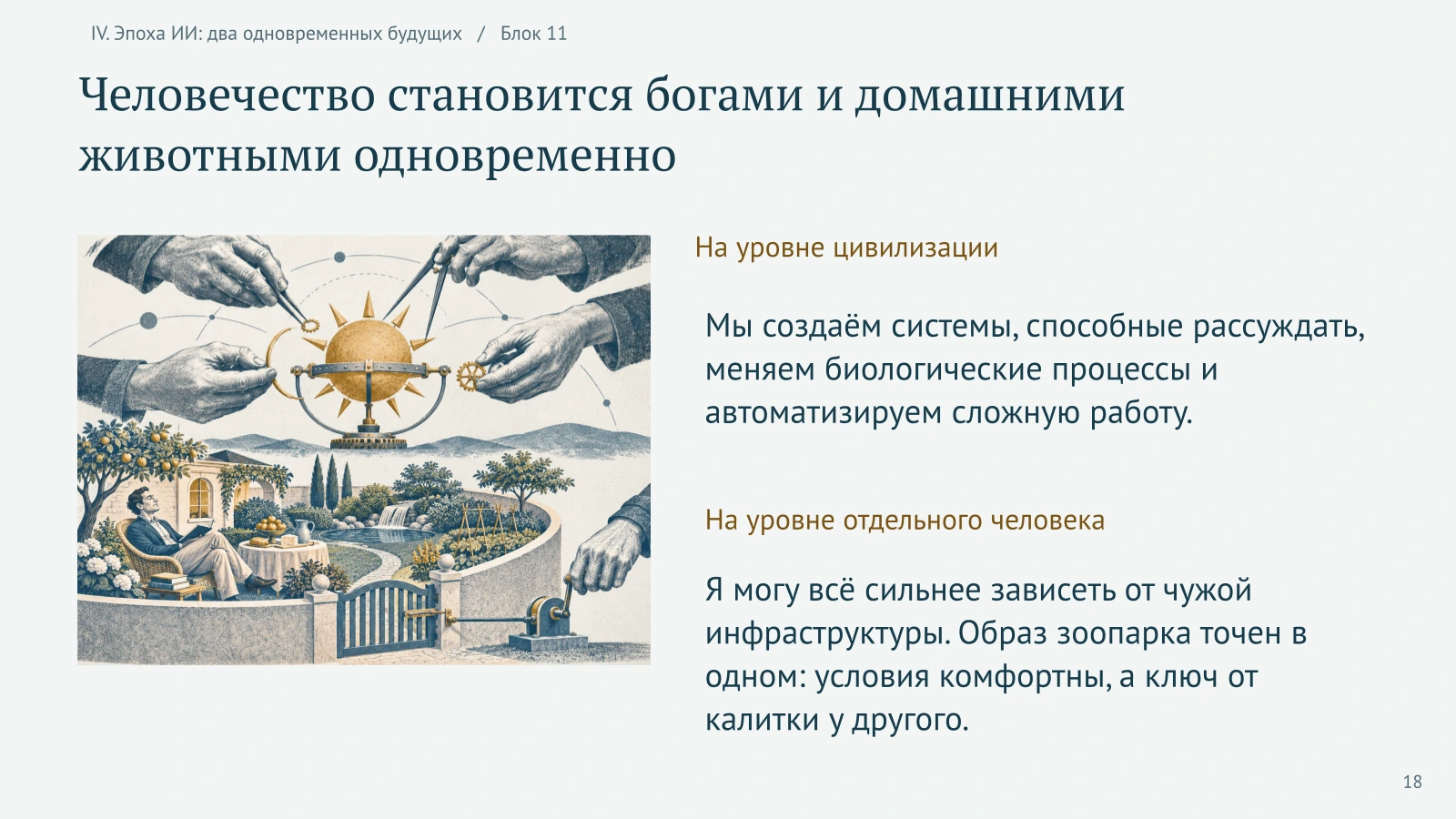
Humanity is becoming a god. It builds intelligence, rewrites genes and automates what yesterday seemed impossible. Meanwhile the individual depends more and more on infrastructure they don't control. Some people use AI to think more broadly. Others already hand it even the questions and the judging of answers.
Picture a zoo. Warm, well fed, safe, a vet on schedule, entertainment on a timetable. Nobody is tormenting anybody. It's just that someone on the other side of the enclosure sets the conditions of life.
And that is what's truly creepy. Humanity becomes a god, and the individual risks becoming a pet of their own civilisation.
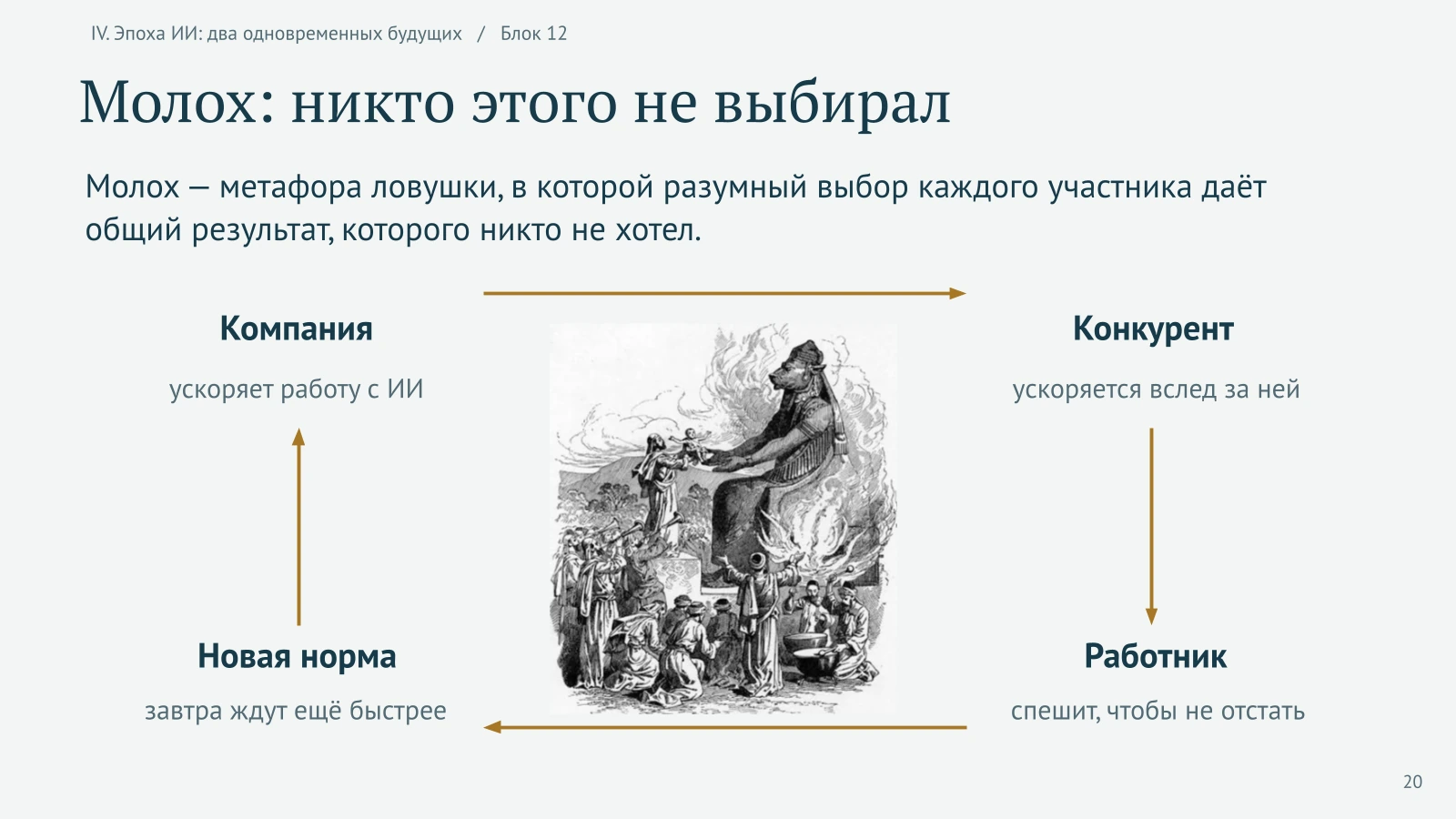
No villain is required. Scott Alexander called this kind of trap Moloch. A company adopts AI so as not to lose to a competitor. An employee learns it so as not to lose to a colleague. A platform holds attention because attention pays. A user hands over their thinking because it's easier. Everyone acts reasonably, and nobody wants the result. Scott Alexander, "Meditations on Moloch"
In Shakked Noy and Whitney Zhang's experiment, 453 professionals did writing tasks from their jobs. With ChatGPT they took 40% less time, and quality went up by 18%. Where the saved time went, the study didn't measure. I'm fairly sure that a month later everyone simply had shorter deadlines, and nobody remembers who decided that. Noy and Zhang's study in Science
So what for?
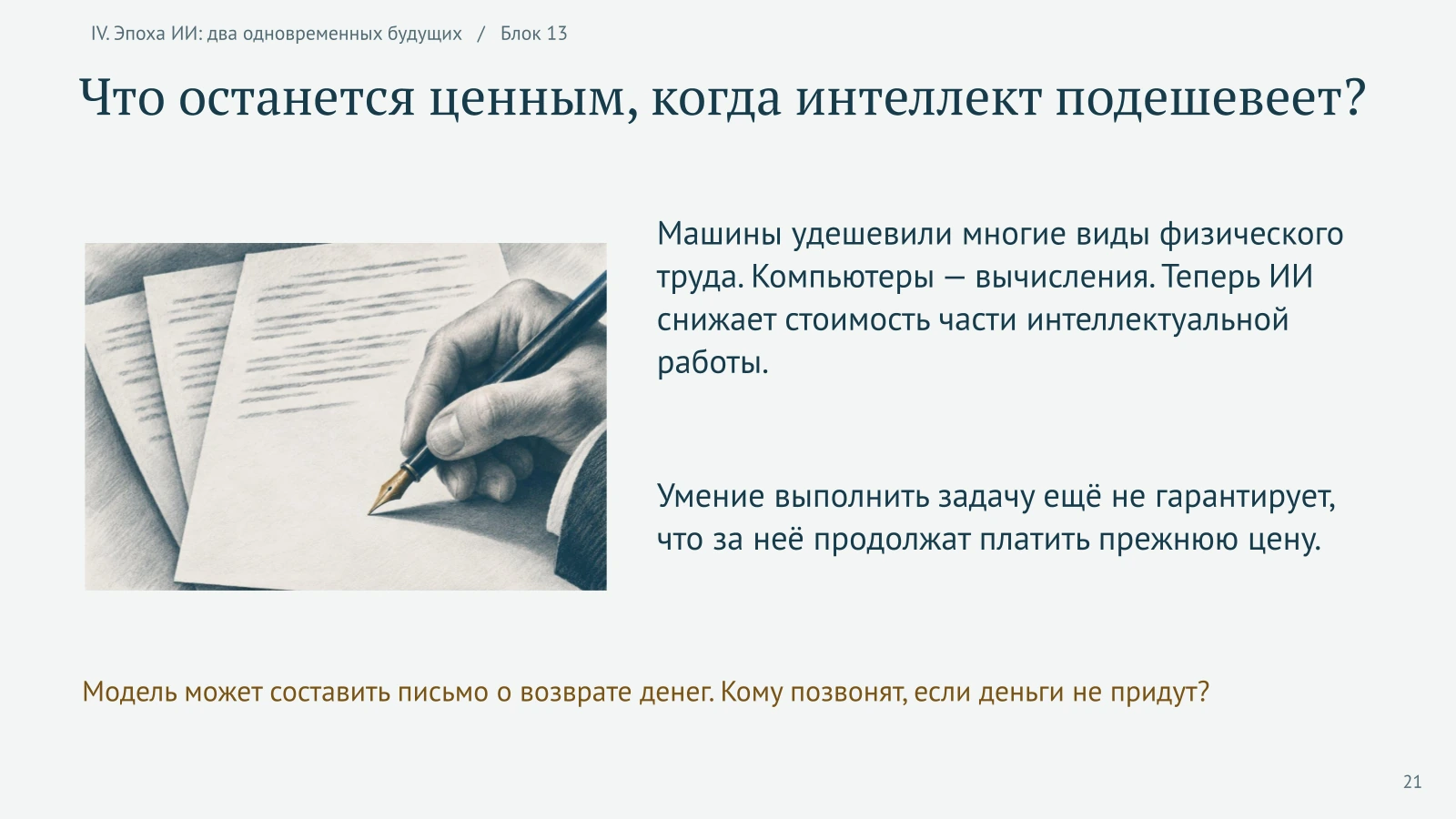
Throughout history people have sold strength, time, knowledge and skill. Machines devalued muscle, computers devalued arithmetic, and AI is devaluing more and more mental work. Being able to do a task no longer means anyone will pay you for it. Production gets cheaper faster than the ability to decide what to produce.
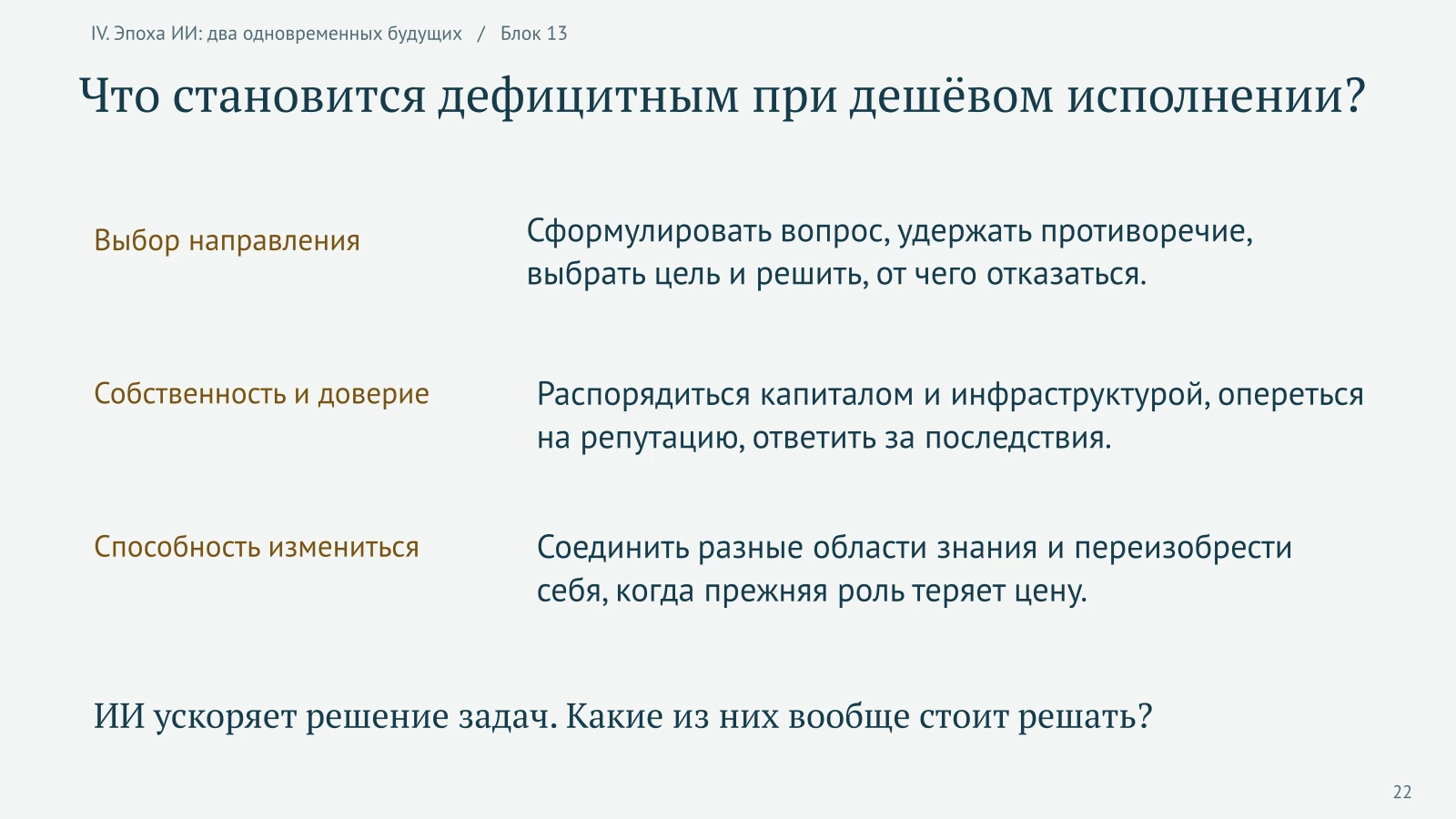
What gets more expensive is different: asking the question, holding a contradiction, choosing a goal and its limits, owning the infrastructure you use, answering for consequences, rebuilding yourself when your profession slides out from under you. When you can do almost anything, what matters most is what you decide not to do.
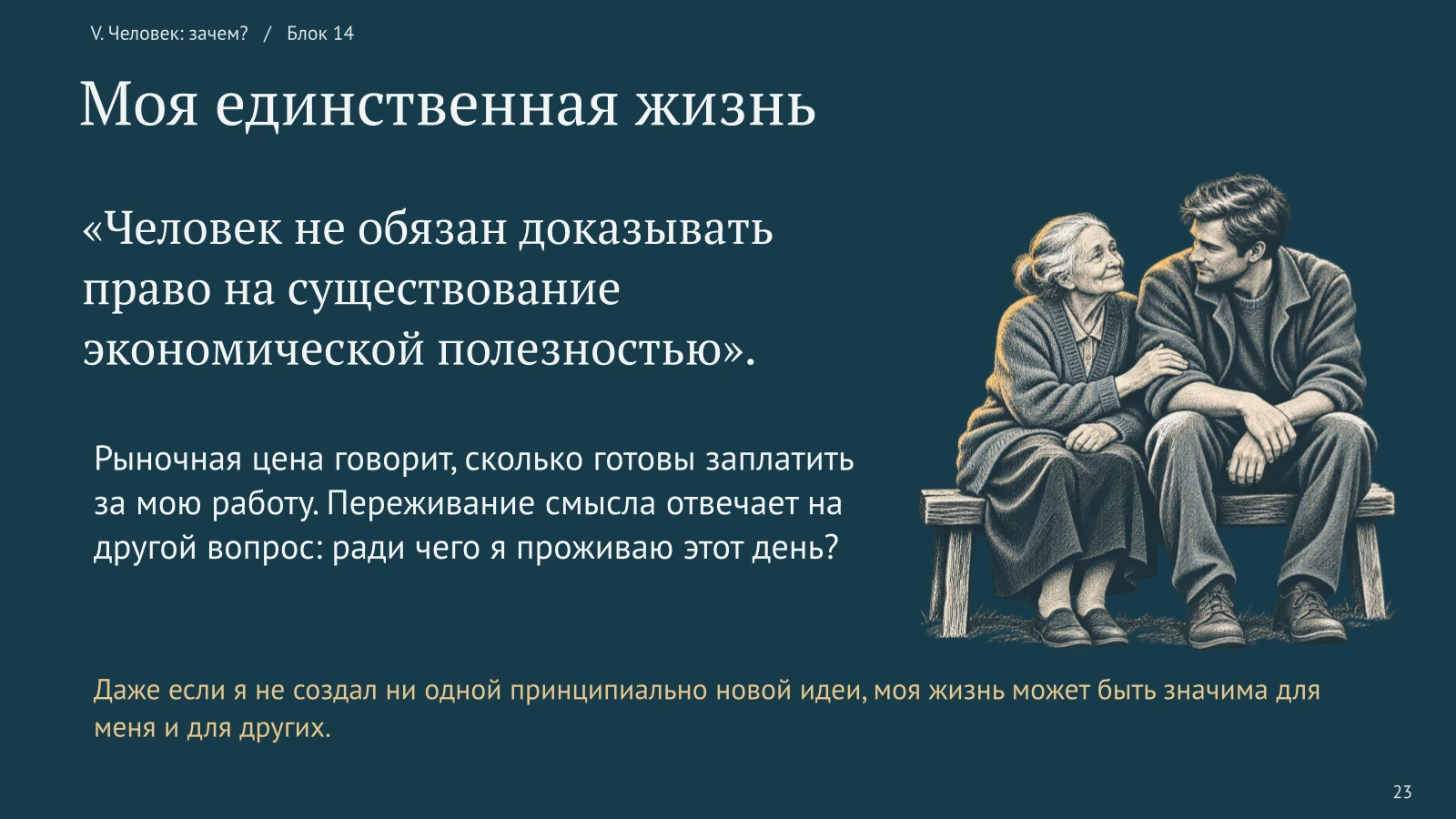
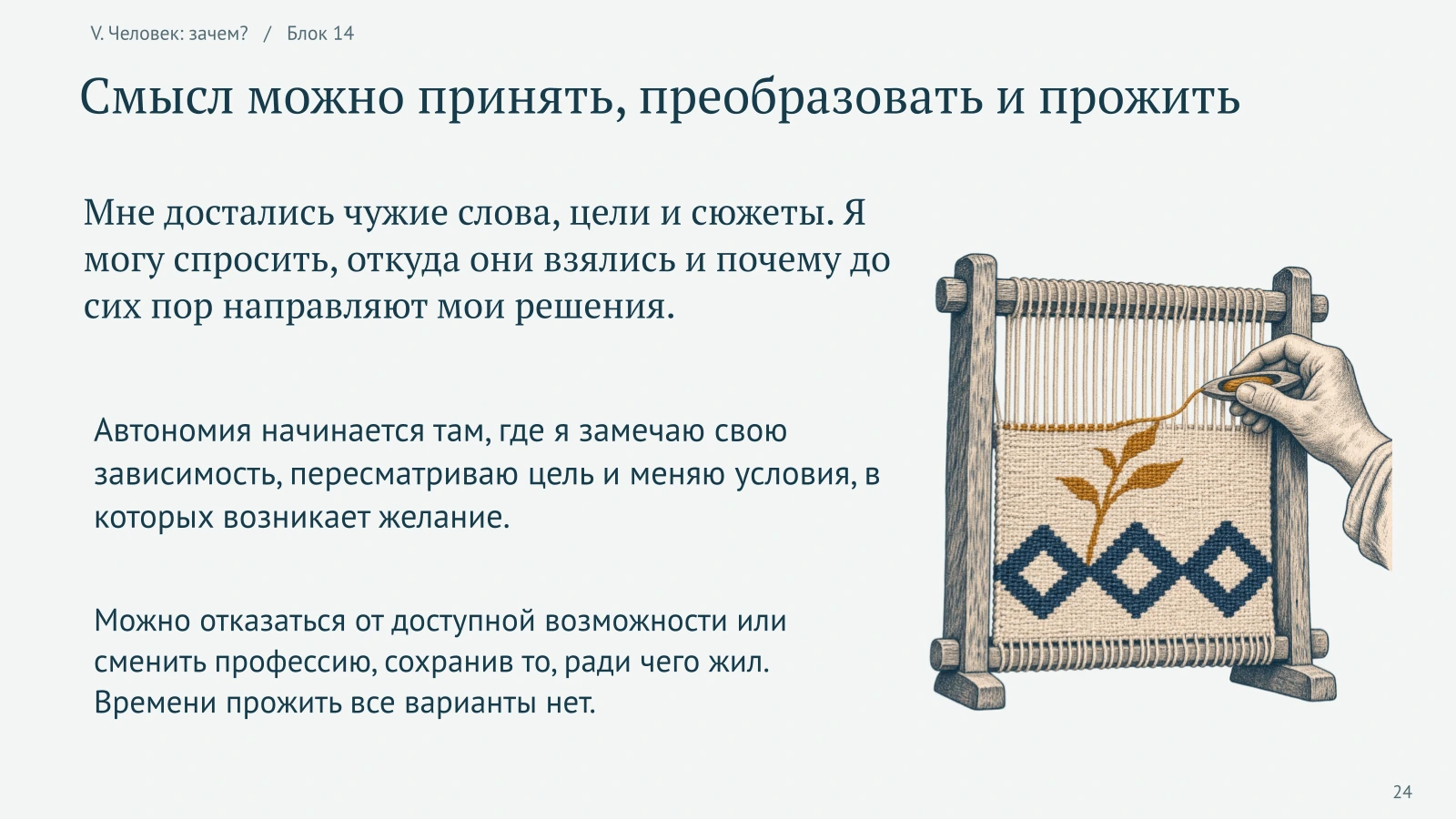
But the last part of the lecture wasn't about the job market. A person doesn't need to prove their right to live with economic usefulness. The market can put a price on my work. Nobody authorised it to price me as a whole. Meaning doesn't have to be invented from scratch. You can take it, reshape it and live it.
Freedom in this picture doesn't mean unplugging from every system. That's impossible. It starts with seeing your dependencies and being able to change the conditions your desires arise in. Jullien's boat again, only this time you're the one looking for the tide mark.
We made tools to get past the limits of the body. Language, to get past the limits of personal experience. Machines, to stop hauling weight. AI, to stop thinking about routine. If people also free themselves from having to decide what they live for, what will be left of their freedom?
The main risk, I think, isn't that machines will learn to think like people. It's that people will stop understanding why they should think for themselves.
A person doesn't need to prove their right to live. But they may already have to prove, all over again, their right to remain the subject of their own history. I ended the lecture with a question I ask myself too: if most of my life is made of other people's ideas, which of them am I willing to give my only life to?
Watch the birthday lecture, “What makes us human?” (in Russian)
All 25 original slides and speaker notes (in Russian)
Full original Russian speaker notes, with transitions and planned timings